



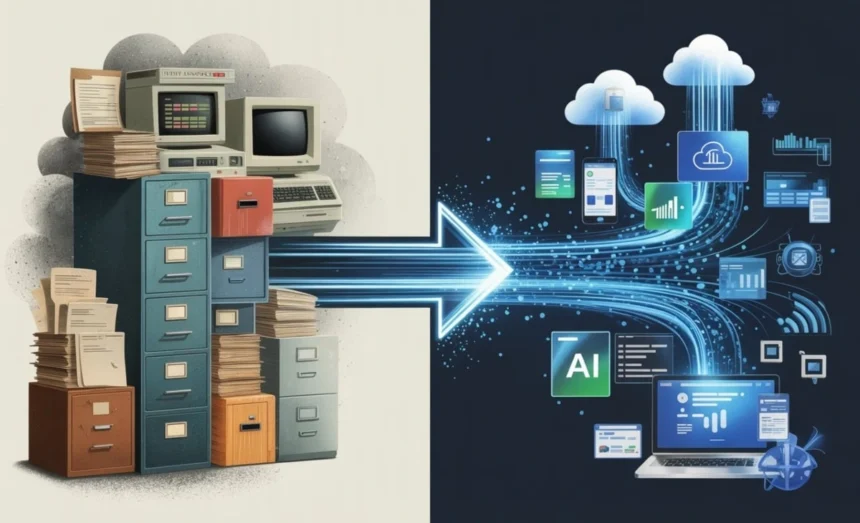
Insurance providers today face a serious problem caused by the limits of their legacy systems. Legacy System were created many decades ago using older programming languages and framework designs as a single piece and tend to require a lot of customization to support an organisation’s individual needs.
They store important data, allow insurers to carry out core functions, and are cumbersome to manage; therefore, anything that changes (e.g., the economy, new regulations, etc.) will likely require additional modifications. With the growing demand for fast-moving digital channels and analytics-driven decision-making, insurance companies that continue to use legacy systems will be left behind due to lack of the flexibility and support they will need to survive in the ever-competitive digital landscape.
Understanding Legacy Systems in Insurance
Typical legacy insurance systems have been around since decades and are very old monolithic platforms built with old programming languages/architecture. Most legacy systems have been heavily customized and become very difficult to maintain. Legacy insurance systems are not able to connect to any modern technology.
Therefore, they will remain unable to evolve and adapt as new customer expectations, regulatory requirements, and different business models emerge. With reliance on legacy systems comes increased integration complexity, more manual processes, and a greater degree of operational risk than would otherwise exist.
A modern insurance ecosystem must include flexible and modular architecture that can easily integrate with additional data sources, utilize analytics effectively, and provide opportunities for digital channels to be utilized efficiently.
Why Legacy Systems Are a Risk for Insurers in 2025?
As the digital economy continues to evolve at a rapid pace, insurance providers who maintain outdated systems will expose themselves to several significant risks, which could jeopardize their competitiveness and create security threats for their clients.
Security Vulnerabilities and Cyber Risks
The availability of modern security technologies for cyber threats, such as encrypted communications and intrusion detection systems, has made older systems more vulnerable to cyber crime. In effect, continued reliance on “legacy” systems exposes insurers to a variety of exposures, including criminal attacks, data breaches, and regulatory compliance exposure, along with fines, penalties, reputational harm, and loss of customer confidence.
The only way for insurers to protect sensitive data and protect their companies from regulatory violations is by transitioning to a modern platform that has integrated security capabilities, including encryption and continuous vulnerability assessments.
High Maintenance Costs
Legacy systems require ongoing investments in hardware and outdated software licensing and require specialized skill sets to maintain and troubleshoot. As legacy systems age and vendor support diminishes, the ongoing investment associated with maintaining a legacy system increases incrementally.
Moreover, fixing bugs and integrating new features into legacy systems require continued significant resources, and thus further delays any innovations an insurer is attempting to pursue. With continuing low margins combined with tighter IT budgets, insurers must consider the long-term benefits of transitioning away from outdated infrastructure and modernizing their systems to create better operational efficiencies.
Inability to Support Digital Transformation
The inability to connect legacy systems with current and upcoming digital channels, APIs and third-party integrations limits the ability of insurance companies to continue to provide seamless and unified multi-channel experiences for their customers. It also limits the ability for insurers to provide their customers with the policy servicing they expect in real time, as well as innovative offerings such as usage-based insurance and embedded coverages.
Regulatory Compliance Challenges
Another challenge insurers face due to their reliance on legacy systems is compliance to an ever-evolving regulatory landscape. There has been continued evolution in regulation, particularly with regard to data privacy, anti-money laundering, and the manner in which companies are required to report. Because of this continued evolution, many legacy systems lack the ability to quickly adapt to changes, resulting in the potential for non-compliance, penalties, and interruptions to an insurer’s operations.
Benefits of Modernizing Legacy Insurance Systems
By upgrading legacy systems, insurers can take advantage of still existing systems that were built long before today’s needs. Modernized systems offer automation, integrated data workflows, and streamlined operations that eliminate the need for as many human resources to be engaged in the processes. Automated underwriting, claims processing, and customer onboarding will save the insurer and customer costs while being more accurate and quicker to complete than manual interventions.
Improved Operational Efficiency
Modern systems leverage automation, integrated data flows, and streamlined workflows to significantly reduce manual intervention. Automated underwriting, claims processing, and customer onboarding not only cut costs but also improve accuracy and speed. An efficient infrastructure allows staff to focus on high-value tasks rather than fixing bugs or reconciling inconsistent data, translating into a competitive edge in service delivery and cost management.
Faster Claims and Underwriting Processes
Additionally, the excessive burdens associated with legacy technology lead to bottlenecks in the underwriting and claims processing cycles of a business. Modern technology allows you and your team to collect data and validate submissions on a real-time basis and to make decisions immediately based on the data that has been collected. Moving to natural intelligence models for assessing risk will reduce your average cycles for underwriting from multiple weeks to only hours and significantly reduce the time required to settle claims, resulting in a better customer experience and higher levels of customer loyalty.
Lower IT Costs
Continuing on with legacy support contracts or on-premise systems creates unnecessary IT costs while moving to a cloud-based platform will eliminate the need to purchase expensive server and storage hardware, reduce contracted license fees over time and will allow businesses to take advantage of cloud technology’s ability to scale, become more efficient, and recover from disaster recovery scenarios in significantly shorter times leading to less system downtime and risk to an organization’s operations.
Enhanced Customer Experience
Along with providing a more user-friendly interface and improved processing speed, a more digital system can help retain existing customers and attract new digital-savvy customers through ease of use, due to the accessibility of digital self-service portals, mobile applications, and chatbots that provide instant and personalized service at any time from any location; all this combined creates a greater sense of trust and satisfaction among customers.
Better Data Analytics and Reporting
With traditional systems, data was typically stored separately in “silos,” thus restricting access to that data as well as making it challenging to perform meaningful analysis. Because modern systems unify all of their data into one system for advanced analytical capabilities, and many incorporate third-party data sources, insurers are able to analyze their pricing strategies, determine the best risks to underwrite or insure, detect fraudulent behavior and proactively implement preventive measures.
Popular Modernization Strategies for Insurance Companies
One of the many ways to update a legacy system is to use a variety of different strategies, depending on the goals of the company and the level of risk involved. In addition, the budget allocated for updating a legacy system will determine the method selected.
Replatforming
Replatforming is the process of moving the main elements of an application from on-premises to a cloud environment while preserving the business rules and existing workflows. By using this approach, organizations can take advantage of the benefits of cloud computing such as elasticity, automation, and quick deployment.
Refactoring and Rearchitecting
This method involves making changes to the code of a legacy system by either rewriting portions of it or reorganizing how it is structured. The goal of refactoring may be to improve the speed, scalability, and maintainability of a given system.
Full System Replacement
Complete replacement of a legacy system may be necessary due to the extreme inflexibility of that particular system and/or in situations where the technology within that system is obsoleting. Complete replacement of a legacy system typically requires using new technology to build a new application using microservices, APIs, and artificial intelligence capabilities.
How Cloud Migration Supports Insurance Modernization?
The cloud will allow for enhanced insurance system modernization capabilities; it is also a tool that provides scalability, flexibility & cost-effective solutions for insurers.
- The scalability of cloud infrastructure: The cloud has the ability to dynamically scale to meet the needs of peak demand. For example, catastrophic events or policy enrollment. A cloud infrastructure eliminates the need for over-provisioning cloud infrastructure, reducing capital expenditures (capex).
- Rapid deployment: With cloud-native architecture, insurers can quickly deploy new applications or features to the market. This agility provides insurers the opportunity to respond quickly to market opportunities.
- Consolidation of insurance data: Insurers can use large amounts of internal and external data that are available via the cloud to provide improved insight for underwriting and risk management.
- Security and compliance enhancement: Cloud providers provide security controls that are built-in and offer continuous monitoring and compliance certification that makes meeting regulatory requirements for data security easier.
Integrating AI, ML, and Automation into Modern Insurance Systems
Automation of routine processes and AI-based predictive modeling are leading the externalization of future modernization programs with health insurance software development.
- Automated claims processing through synthetic space enables faster and more precise settlement for claims processing by utilizing AI technology, along with advanced predictive underwriting capabilities, using machine learning methods (ML) to analyze multiple risk elements and develop a comprehensive understanding of the likelihood of risk against individual policyholders.
- Automated capture of data related to fraud through AI models can help to identify and verify transactions quickly and accurately while simultaneously identifying potential fraud and non-fraud transactions. In their entirety, it has been estimated that fraud could save millions of dollars each year in lost business income.
Conclusion
For modern insurers to remain competitive going forward into 2025, modernizing legacy insurance technology should no longer be considered just an option but instead, a strategic choice. Insurers are able to maintain competitiveness using various methods such as partnering with an experienced Insurance Software Development Company in order to take advantage of replatforming, migrating to cloud-based systems and incorporating automated processes powered by artificial intelligence.